
Oregon Financial Literacy Statistics
The Oregon Financial Educators Council (OFEC) gathers data and conducts research to illustrate the state of financial wellness among Oregon residents; and regularly updates and maintains these findings on this website. The purpose of providing and refreshing these data is to equip policymakers, community organizations, researchers, and engaged individuals with resources that support advocacy for financial literacy education legislation and the effective implementation of such policies once enacted. By sharing these statistics, the Oregon Council advances its mission to strengthen the financial wellness movement throughout the Beaver State and across the nation.
Cost of Financial Illiteracy Survey
Oregonians report that lack of financial knowledge carries a high cost, according to the NFEC’s most recent survey. Participants across the state responded to the single question: “During the past year, about how much money do you think you lost because you lacked knowledge about personal finances?” The results are shown below. Since 2017, the NFEC has conducted this annual survey, consistently revealing that the average individual cost of financial illiteracy approaches or exceeds $1,000 per person – with estimated national losses reaching into the hundreds of billions of dollars each year, and losses in the hundreds of millions across Oregon.
Cost of Financial Illiteracy
$0 – $499
$500 – $999
$1,000 – $2,499
$2,500 – $9,999
$10,000 +
Financial Vulnerability in Oregon
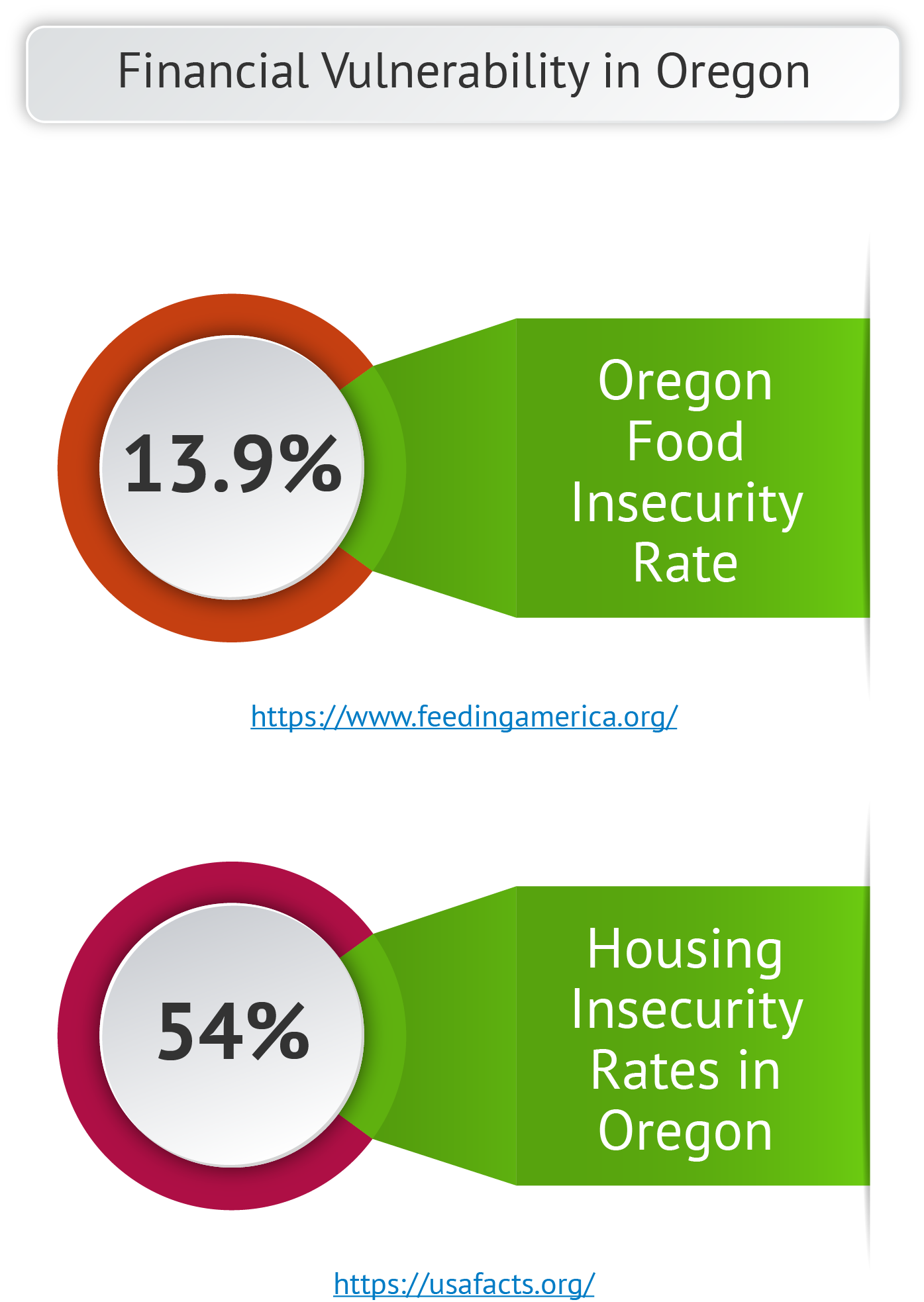
For the purposes of these statistics, we use two key metrics to indicate financial vulnerability in a given region: food insecurity and housing insecurity. Oregon’s food insecurity situation is characterized by the nonprofit Feeding America, which states that approximately 1 in 7 Oregonians (13.9%) currently faces hunger; and 145,060 of those individuals are children. Out of the Oregon households receiving Supplemental Nutrition Assistance Program (SNAP) benefits, 28.2% have children in the home.
Housing insecurity represents a significant Oregon problem, with a total of 22,875 unhoused individuals living in the state as of 2024 – creating a homeless rate of 54%, according to the World Population Review. That proportion represents a 30% increase since 2007.
Specific Data on Oregonians’ Financial Situation
Average Total Consumer Debt
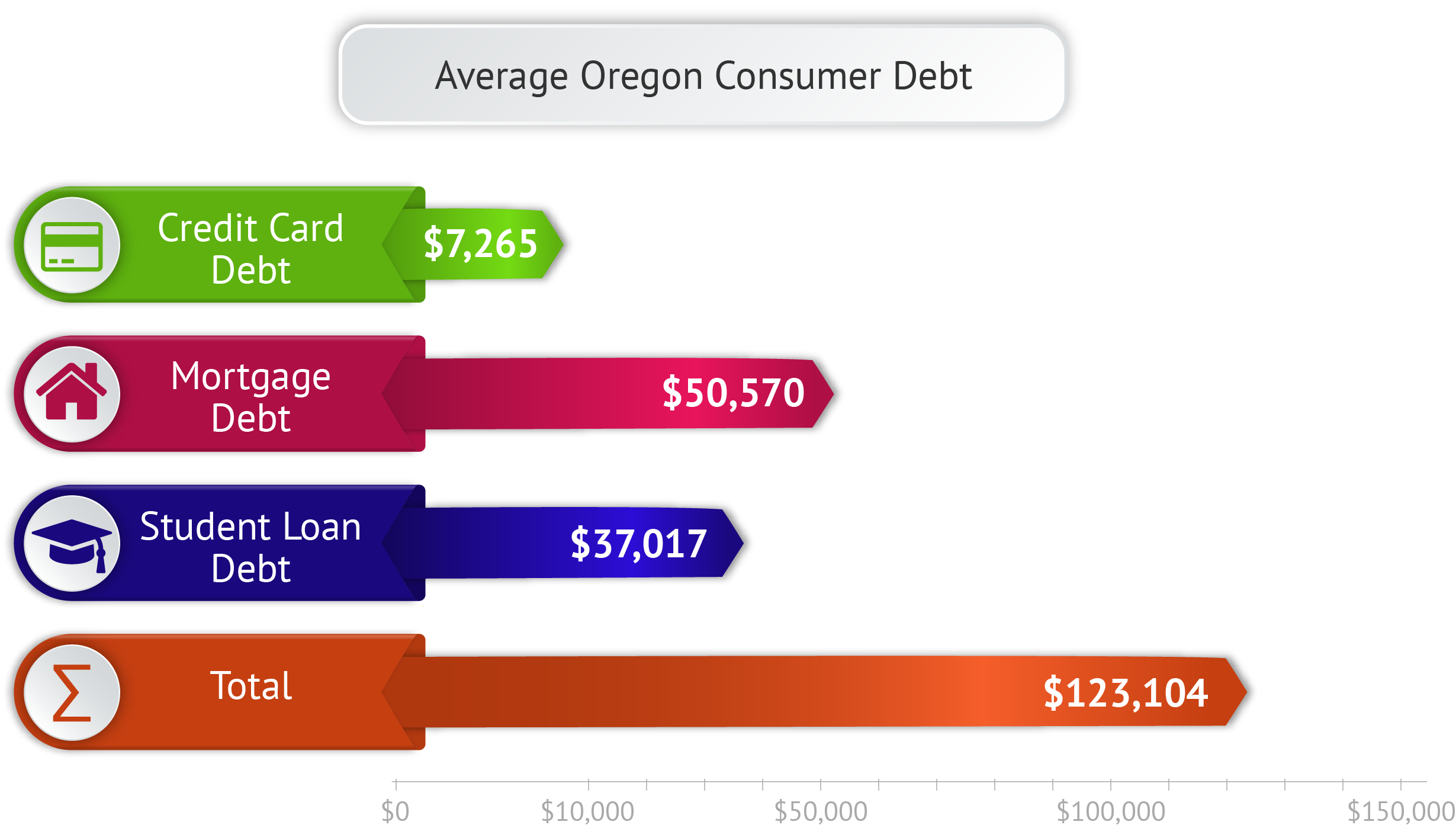
Debt loads in the U.S. reached record highs in 2025, soaring above $18 trillion in total with an average owed per consumer of $104,755. Data provided by Experian indicate that the average Oregon consumer carries a debt burden of $123,104, well above the national average. However, that figure had decreased slightly (–0.6%) from the 2024 calculation.
Oregon Debt Levels by Type
More specific statistics from the World Population Review show that Oregonians who have student loan debt owe $37,017 on average. WalletHub reports that the average Oregon balance per user on credit cards was $7,265 and their delinquency rate was 8.48%. All these data points were reported in 2026.
Regarding mortgage debt, Oregon ranked 14th in the nation in 2024 according to World Population Review, with state homeowners carrying an average mortgage balance of $50,570.
Oregon Financial Literacy Education and Legislative Statistics
The National Education Association (NEA) produces regular reports on the number of schools, teachers, and students enrolled in each U.S. state. During the 2023-24 school year, the organization indicated that Oregon had 222 operating public school districts, ranking the state 23rd in the country. Total student enrollment in the Beaver State that year was 547,424 with 31,601 teachers employed – a student-to-teacher ratio of 17.3 to 1.
Financial literacy education has been on the Oregon legislature’s radar since 2007, when Chapter 773 (HB 2584) was passed establishing a Task Force on Civics and Financial Education. The final report issued by the Task Force in 2008 recommended including financial literacy as an “Essential Skill for an Oregon Diploma” and pursuing “the possible use of the additional credit required in mathematics for personal finance applications,” but there is no evidence that any action was taken on those recommendations.
The Chapter 133 (HB 2229) enacted in 2017 was a bill that encouraged districts to offer financial literacy coursework as electives, but did not mandate that financial literacy be offered.
In earlier years the state had required students to complete a personal finance course to graduate from high school, but that mandate was removed in 1997 to free up instructional time for other subjects considered more important at the time. In 2023 the Oregon Senate passed Senate Bill 3 reinstating the mandate, with the bill stating, “In order to receive a high school diploma from a school district or public charter school, a student must satisfy the requirements established by the State Board of Education and the school district or public charter school and, while in grades 9 through 12, must complete at least 24 total credits, which must include at least:… (E) One half-credit of personal financial education.”